Showing posts with label stitching. Show all posts

Saturday, April 11, 2015

laptop jumper mend

My laptop cover has been in constant use since May 2011 when this happened ...
Funny that the jumper I never wore has become so 'well worn' now. This is the 4th round of mending that it has needed - applying a combo of swiss darning and grafting, using the yarn that I also use for this, and this ongoing project (cardis or socks always on the go now). The material flows across and through various making and objects, linking these things forever.

The mend prior to this was a rather desperate, post PhD, 'plug all the holes that I hadn't attended to in a long time' affair. This time there were only a couple of little holes developing, and this time attended to in good time.


Wednesday, January 18, 2012

gold elbow patches are all the rage in downtown carnegie

I've been meaning to get back to the ol' bloggin' the last couple of days...I'll do a proper catch up post tomorrow, but at the mo I'm bursting after stumbling on something quite amazing while walking the doggles at the park this evening...

Downtown Carnegie we're talkin' bout here...there was what seemed to be a usual posse of ol' guys at the local park, but as I walked past I caught a flash of a full set of gold teeth from one of them...flavor flav style...boo yeah!  Then as two of them walked down the path in front of me I saw this...fantastic!


I couldn't resist stopping this gentleman and asking him if I could take a pic....


It's an old skool double knit cardi which he told me that he likes so much that his wife put the patches on when the elbows wore through (I did ask him if he put the patches on himself!)  He looked very suprised when I said I liked them very much...ooo I so do!  I didn't realise at the time either how striking the rest of his clothing was until looking at the pics...I was so absorbed by the elbow patches!


Can u believe it, gold leather, bling-ca-ching...and so effortless!  I've been thinking a lot about visible mending and alterations along the lines of Kevin McCloud endorsed readable history...what a beautiful example this is!...I actually have a project in the pipeline along these lines already so what an incredible thing to stumble upon ♥♥♥

Wednesday, December 7, 2011

lanvin beetles

At Assin on the weekend I was oooing and ahhhing over this Lanvin tee with a sprinkling of sequin beetles...It was seriously beautiful, the pic doesn't do it justice (found at ssense here)...


 You can see the detail better here where the sequin embroidery has been applied to a pair of trainers (pic from styleflavours)...


Such a beautiful example of a craft/fashion collision :o)

Tuesday, August 2, 2011

apron parts...to glean or not to glean?


The aim of the summer gleaning workshop was to glean and cut the cloth into to parts and sew these parts into aprons.  The apron pattern was the starting point for the design of the print for the cloth.  This pattern acts literally and metaphorically as the building blocks for the design.

Each apron skirt is a brick, and the waistband/tie panels look like the weather boards of the summer gleaning 'house'.  Reflecting back on this process makes me wonder whether this is really gleaning if this intentional use of the cloth actually partly shaped its design.  It is the leftovers from another use of the cloth, but it was one that I intended and embedded into it, although not at the inception of the project.  The initial idea was to create a canopy of cloth that would evoke to the viewer/occupant an experience of a bygone summer.  The canopy is like a harvesting machine that I knew was going to be imperfect in gathering the entire crop, so knowing that this would be the case, I thought about how the gleaning after the canopy could take place.  This projected action shaped the gleaning cloth.  Notions of harvesting and gleaning get rather slippery here, the cloth in some ways harvests, and in other ways gleans.  I feel that the obvious is a harvest, and the peripheral, less tangible aspects are gleanings.

Friday, June 17, 2011

hug a laptop

A while ago I posted about my laptop screen saga and I have since bought a nice new macbook air.  Of course I want to protect this one, so I used some of my surrounding bits n pieces to keep it safe.
I used a jumper that I had hanging about in the studio which I had never worn much.  I experimented with how the laptop might interact with parts of the jumper.  I was intending to cut the jumper into parts to make a layered cover, but ended up folding and wrapping to completely encase the laptop with layers of the jumper.  It is held in place by strategic and minimal stitching which could easily be removed to give the jumper back its life as a human garment.  The performativity of the jumper is played out as the sleeves wrap around and our human centered interpretation of the garment gives the perception of holding, hugging, nurturing.


Wednesday, February 16, 2011

1960's and 1970's Japanese aprons

One of the responses to working and being inspired by the garden is to make aprons for gathering actions - as seen in some of the preserving party pics and along the way.
Here's some of my favourite examples of vintage aprons from the Kamakura-Shobo Publishing Co. Pattern Drafting books Vol. 1, 2, and 3, published in 1967, 1970 and 1972.  My nanna brought Vol. 2 back from Japan around that time, and I always poured over it when I was young :o)


Monday, January 31, 2011

Response through Making


Another aspect of Material Expression is Response through Making.  Being responsive through the making process is similar to rendering a wall where the material tells you what action is required.  In the example of the calf leg shirt, the response was via sight when piecing the shirt together.  When stitching the pieces together, the response is via touch as tactile information is gleaned regarding the pliancy of the strips of leather when using it to stitch.  As the “situation talks back” (Schon 1983, p.79) the information is fed back into the process.


Saturday, January 29, 2011

Leather Patina

Aged patina mentioned by busyman last week brought this back to my mind.  It's something I need to keep in mind when working with the material expression of leather.


Tuesday, August 10, 2010

North American "northern plains" moccasins

One of the suggestions from GRC (graduate research conference - where we present our work to a panel of critics), was to look at some ethnographic sources, American Indian/Inuit cultures etc. to see how the skin of animals was traditionally used.
I'm going to experiment with a couple of examples of garments/shoes from the book:
Robes of White Shell and Sunrise (Conn, R & Denver Art, M 1974, Robes of white shell and sunrise : personal decorative arts of the native American : [catalogue of an exhibition] Denver Art Museum, November 9, 1974-January 19, 1975, Denver Art Museum, Denver.) - thanks Sue!

  
The first example is a pair of moccasins cut from one piece of leather - one piece for each shoe that is! (p. 30 - 31)

  
I photocopied the pattern onto an A4 sheet, then used a grid to grade it to my size, using the length of my foot as a guide.


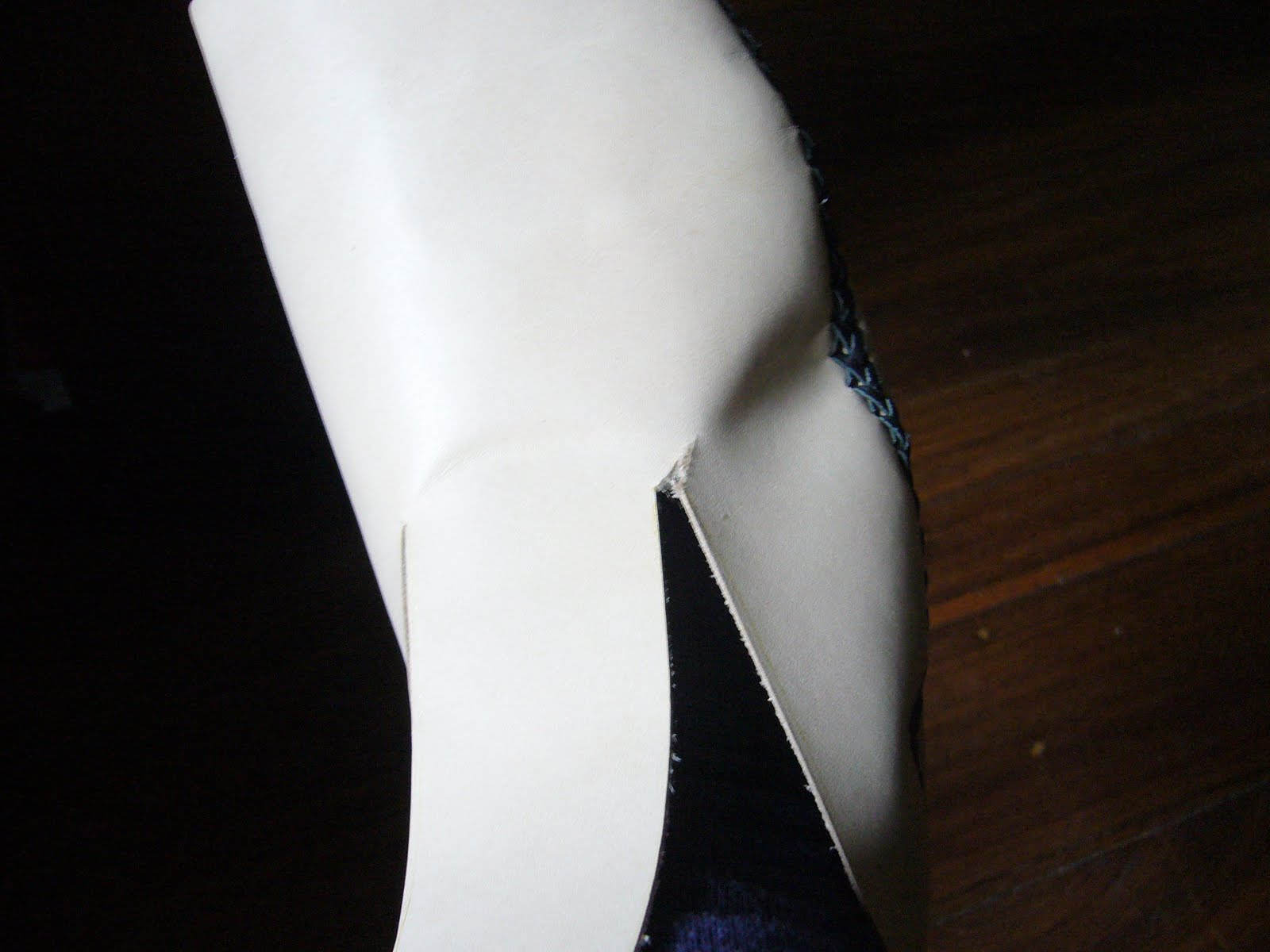
The book says that the moccasins are made from buffalo leather. “Since these moccasins are cut from soft, flexible leather, they soon take on the exact shape of the wearer’s feet” (Conn 1974, p. 30) I chose a side of thin vegetable tanned leather that is mouldable, while still having a firm grain that will hold the shoe shape – it’s a bit like belt leather but a thinner split.


 I needed to work out a way of sewing the shoe together. The original picture looks like it's an overcast stitch, but I was having a look at a leather craft book and decided to use something fancier.


I found this example of “woven stitch” on page 31 – 33 of “Leathercraft by Hand” (Faulkner, J 1976, Leathercraft by hand, Pelham Books, London.) It is quite simple as the holes are punched in a square formation and 1hole used twice as part of the “weave”.


Here’s my punched holes: 


I used a 3mm wide kangaroo thronging that I happened to have at home to lace/sew the shoe together. I’ve never done this before so it was an interesting process. I butted the edges together rather than overlapping like in the leathercraft book.


One side of the centre back seam ended up too long – I didn’t prove/check the pattern as I wanted to use the proportions exactly from the book. The shoe has turned out too large around the foot, so if the size was reduced to make this seam fit, it would improve the fit.


The shoes are a little hard to put on as the cut area which forms the tongue doesn’t quite allow enough room to put the foot in, and the end of the split also becomes a weak point. This weak point tore a little on one of the shoes when first putting it on.


I’m going to wear the shoes as much as I can to see how well they mould to my feet as a test of the properties of the leather. They might not be tight enough for the experiment to work – I may need to make another pair to test further.
 
  
I wore them at home all day today and they are actually very comfortable. Updates coming soon!